
Best Coastal Restoration Project for 2023
The CRT Board is very pleased to announce that the winner of the best Coastal Restoration project for 2023 has been awarded to the Thames-Coromandel District Council and Pauanui Dune Protection Society.
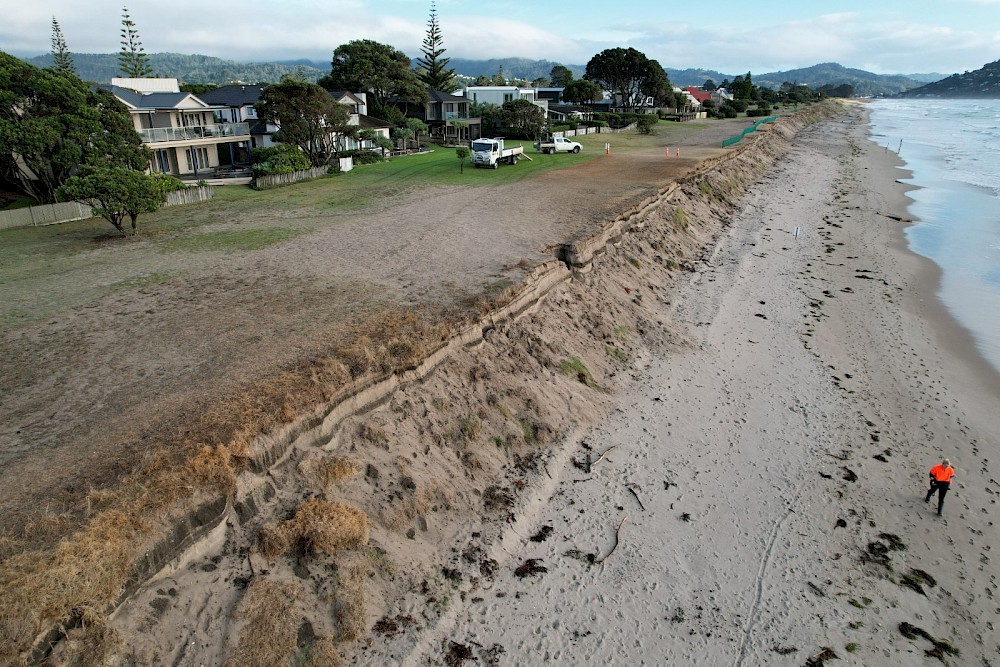
After a cluster of storms in the winter of 2020 and 2021, the coastal zone at Pauanui was significantly impacted because only a narrow strip of the coast had been restored. A large area of grass behind this strip of dune was considered an important recreation area: however, this was at risk from further coastal erosion.
TCDC provided options on how to prevent further erosion of the area, and the CRT Board were very impressed with the way TCDC worked with the community regarding their concerns to extend planting over half of the grassed reserve.
On the back of community meetings, the Pauanui Dune Protection Society was formed, and TCDC and the group sought advice from coastal scientists who confirmed that a much wider dune restoration would provide more resilience to the coastline.
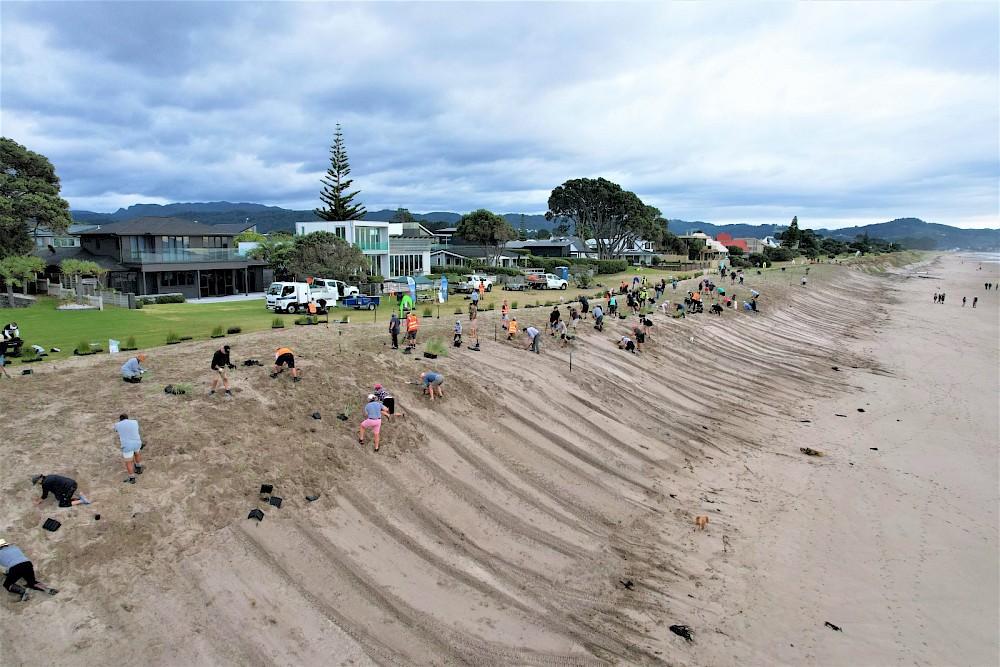
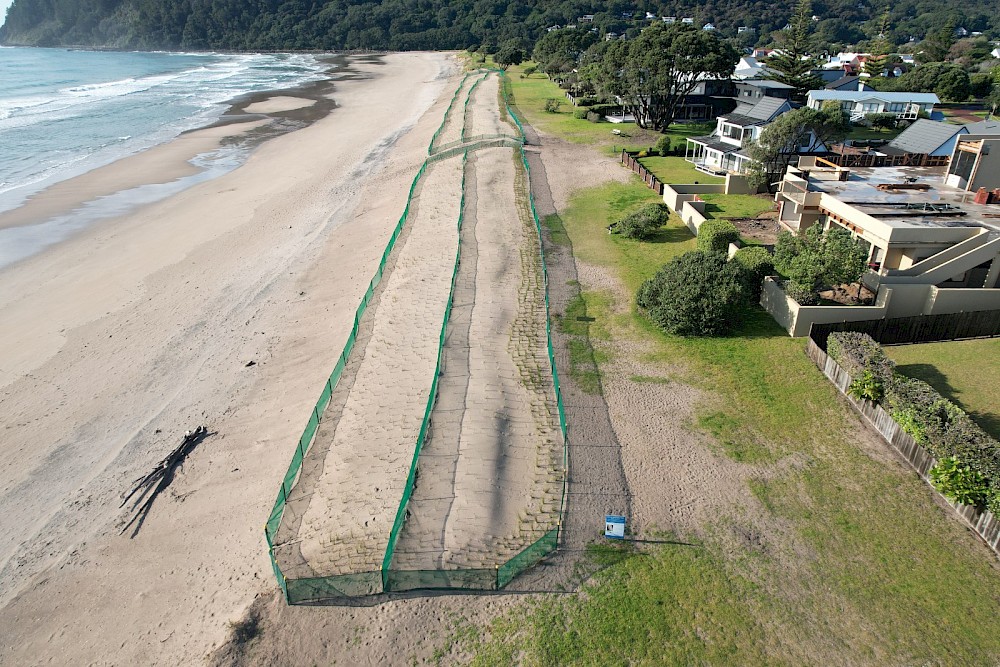
After much communication by TCDC and the Pauanui Dune group, the community consented to the work and in May 2022, 200 volunteers helped plant 13,000 native dune plants over 265m of shoreline. PDPS and TCDC intend to broaden the scope of this work further north and south of the project area.
Jamie Boyle, Coastal Scientist at Thames-Coromandel District Council, explains more about the project:
“For the last two years, the southern shoreline in Pauanui has experienced successive storm events and have been assessed as unprecedented in the history of monitoring at Pauanui (Tonkin and Taylor, 2022). A cluster of storms occurred between April and September 2020, and again from May to October 2021. These storm clusters lasted the duration of winter months, with large and persistent swells recurring every 2-3 weeks and lasting anywhere between 2-10 days.
Unlike a more natural dune system, where successive dune plant zones can accommodate coastal erosion, the narrow Pauanui foredune system is constrained by a large, grassed reserve. Historically, dune restoration in Pauanui has been width-limited (maximum of 5 m) to maintain the highly valued reserve space. However, this has meant that following erosion events in the past, only a very narrow margin of the native sand trapping spinifex and pingao plants had remained. Unfortunately, the events of the last two years removed all native plants and only grassed reserve remained. As a result, all dune self-repair potential was gone.
Using a scientific approach, a much larger restored dune width was proposed to accommodate future erosion events and provide enough remaining plants to self-repair. This width was planned to take up approximately half of the grassed reserve and challenge the use of the reserve space. As such, significant community consultation was required. Thames-Coromandel District Council (TCDC) presented the proposal in a public meeting, and this was initially met with opposition. It was understandable that a one-off presentation is difficult to both contextualise and accept, and particularly when the work required needed a shift in reserve use.
On the back of this meeting, a silver lining emerged with a small group getting together to discuss the merits of what TCDC had proposed. They sought external coastal scientific advice and after much deliberation, consensus was that the work proposed was indeed the most suitable for the current situation and this led to the formation of the ‘Pauanui Dune Protection Society’ (PDPS). Between May 2021 and early 2022, PDPS put in a huge amount of work communicating with Pauanui ratepayers the need to undertake this work and helped disseminate some of the science and misinformation around coastal restoration work. Ultimately, the group and its members grew and gathered a large amount of community support for the project, as well as contributing to the restoration concept design and financing of native plant purchases.
This work culminated in May 2022, where one of NZ’s largest ever (and Thames-Coromandel District Council’s largest) single restoration events took place. We had over 200 volunteers to help put over 13,000 native dune plants in the ground over a 265 m length of shoreline. The success of this event, and the hard graft leading up to it, shows the level of engagement that is both required and pertinent to large-scale restoration work. As a result, PDPS and TCDC intend to broaden the scope of this work further north and south of the project area.
In the face of pending sea level rise and expected coastal erosion, we envisage that the magnitude of coastal restoration required to help combat future impacts needs to increase. The work presented at Pauanui highlights there are challenges in how this is completed. However, with a clear and transparent process that is based on sound science, we believe that this level of coastal restoration is fully achievable and necessary if we want to transform suitable adaptation of the coastal zone.”
You can keep up with the Pauanui Dune Protection Society’s work on the Waikato Coastcare Facebook page, or learn more on the Thames Coromandel District Council website.
Posted: 12 June 2023 in the News category